AI
Apr 23, 2026AI Fundamentals: A Comprehensive Skill Track Completion
Context: 6 courses. 10+ hours. One skill assessment. And a much deeper understanding of the technology reshaping the world. The AI Fundamentals track is officially done!
Context: 6 courses. 10+ hours. One skill assessment. And a much deeper understanding of the technology reshaping the world. The AI Fundamentals track is officially done!
I'm thrilled to share that I've completed the AI Fundamentals skill track on DataCamp!
This track was more than just a set of courses. It was a structured, conceptual deep dive into the ideas powering modern AI — from how machine learning actually works, to how Large Language Models are built, to the ethical responsibilities that come with deploying these systems in the real world.
Here's my honest, detailed breakdown of every course in the track:
Course 1: Introduction to AI for Work
What it's about: The starting point — not about code, but about mindset. This course reframes AI not as a replacement for human work, but as a force multiplier that amplifies what we're already capable of. It covers what AI can and can't do, how to adopt it responsibly in workplace contexts, and how to collaborate with AI tools without losing critical thinking.
Key takeaways:
- AI thrives when paired with human judgment — it accelerates, not replaces.
- The concept of "AI as a collaborator" shifts how you approach delegation and automation.
- Responsible adoption means understanding limitations like hallucinations and data bias before deploying anything.
Benefit to you:
Whether you're a student, professional, or developer, this course resets the framing. It teaches you to ask "how do I leverage this?" instead of "will this replace me?" — a far more productive mindset.
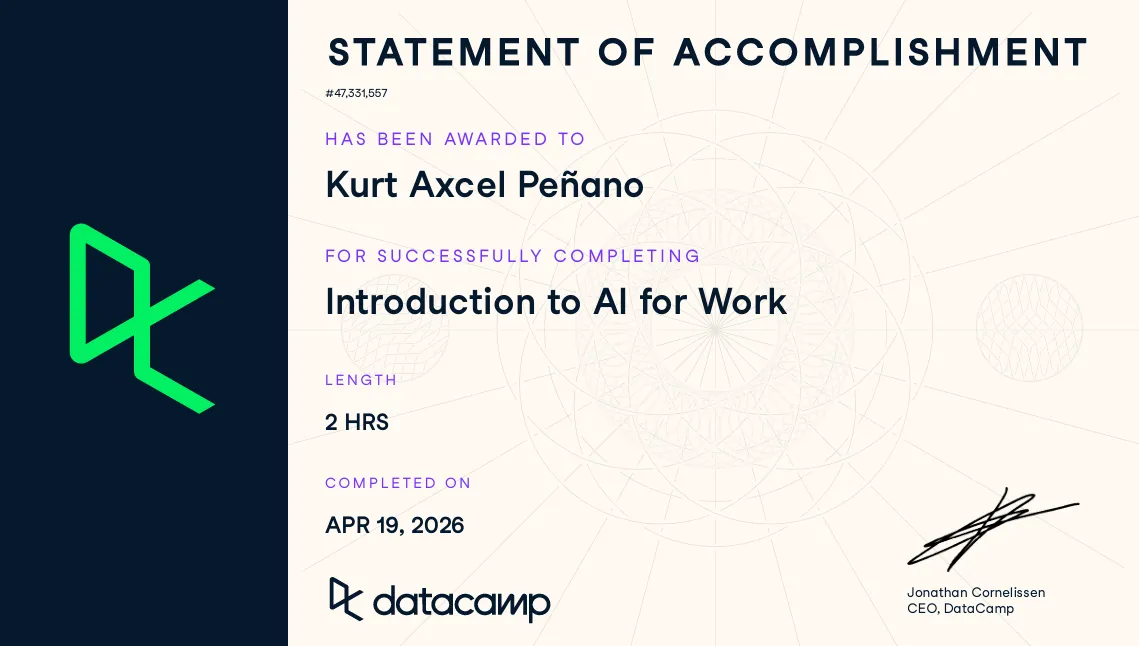
Introduction to AI for Work — Statement of Accomplishment
Introduction to AI for Work — Progress Proof
Course 2: Understanding ChatGPT
What it's about: A practical, hands-on exploration of ChatGPT — from how it processes your prompts to how it's actually being used across industries. The course covers prompt engineering best practices, how context windows affect model behavior, and real business use cases from content generation to code assistance.
Key takeaways:
- Prompt clarity and specificity directly determines output quality — garbage in, garbage out still applies.
- ChatGPT is not a search engine. Understanding the distinction changes how you use it.
- Iterative prompting (refining in conversation) is one of the most underrated skills in working with LLMs.
Benefit to you:
This course essentially unlocks 10x productivity with ChatGPT. The difference between someone who prompts well and someone who doesn't is significant — this closes that gap.
Honest cons:
Some case studies felt dated, and the course doesn't cover GPT-4 features like vision or browsing in depth. But the conceptual foundations still hold.
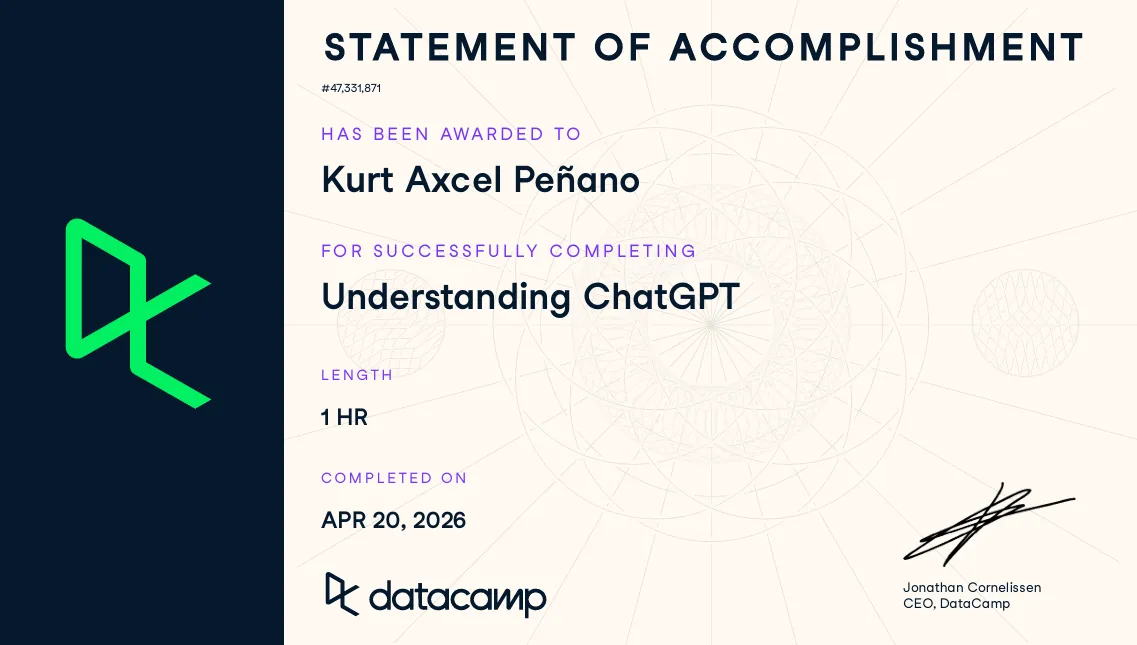
Understanding ChatGPT — Statement of Accomplishment
Understanding ChatGPT — Progress Proof
Course 3: Understanding Machine Learning
What it's about: A no-code, conceptual deep dive into ML. This is where the track gets technical — but accessibly so. It walks through supervised learning (classification, regression), unsupervised learning (clustering), and ends with deep learning and neural networks. The emphasis is on understanding models, not just running them.
Key takeaways:
- Supervised learning is still the workhorse of most real-world AI applications.
- Deep learning is powerful but data-hungry — understanding when not to use it is just as important as knowing how.
- Overfitting vs. underfitting is one of the most practical concepts every developer needs to internalize before touching ML.
Benefit to you:
This course demystifies the "black box." Even if you never write an ML model yourself, understanding these foundations makes you a better developer, product thinker, and consumer of AI tools.
Honest cons:
The deep learning chapter is brief for how vast the topic is — consider it an appetizer, not the main course.
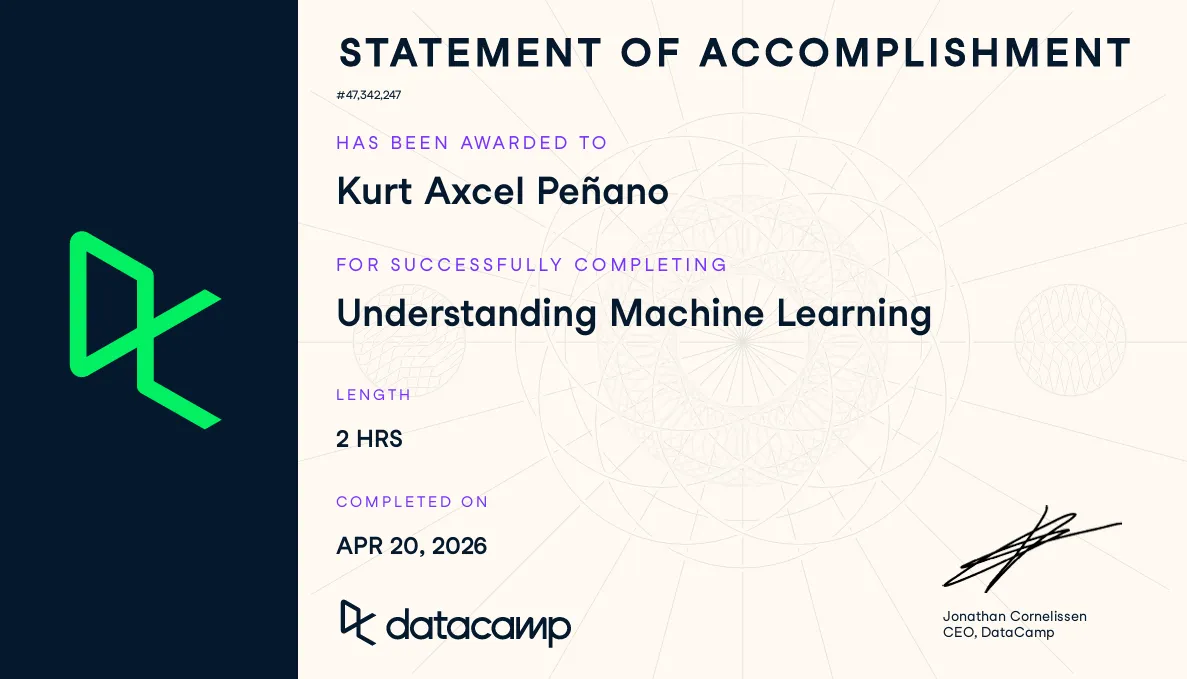
Understanding Machine Learning — Statement of Accomplishment

Understanding Machine Learning — Technical Console Analysis
Course 4: Large Language Models (LLMs) Concepts
What it's about: This is the most intellectually rich course in the track. It covers the full arc of LLMs — from their architecture (transformers, attention mechanisms) to how they're trained (pretraining, fine-tuning, RLHF), to the ethical considerations they introduce, and cutting-edge research directions.
Key takeaways:
- LLMs are not just "bigger ML models" — they represent a paradigm shift in how machines process language.
- RLHF (Reinforcement Learning from Human Feedback) is what makes models like ChatGPT feel aligned — it's a fascinating and critical process.
- Hallucinations aren't bugs — they're a structural consequence of how LLMs predict tokens. Understanding this changes how you use and trust them.
- Concerns like copyright, bias propagation, and energy consumption are legitimate and ongoing.
Benefit to you:
This course gives you the vocabulary and conceptual depth to actually engage in AI discussions at a professional level. Knowing the difference between a pretrained and fine-tuned model, or what a temperature parameter does, matters.
Honest cons:
The pace moves fast through some of the more mathematical concepts. A follow-up course with more implementation depth would make this sing even more.
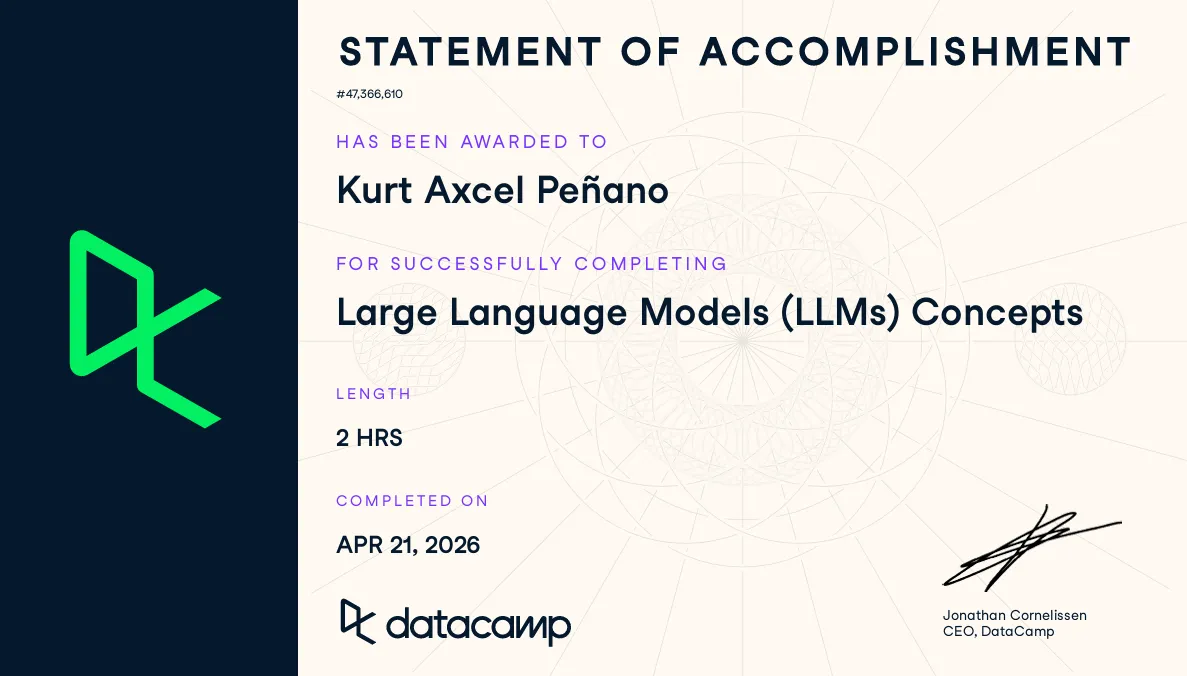
Large Language Models (LLMs) Concepts — Statement of Accomplishment

LLM Architecture Concepts — Progress Proof
Course 5: Generative AI Concepts
What it's about: A focused look at generative AI — not just LLMs, but the full landscape. This course covers how models like GPT, DALL·E, Stable Diffusion, and others are developed, what makes generative output different from discriminative AI, and how society needs to navigate the societal impact of AI-generated content.
Key takeaways:
- Generative AI models learn distributions — they don't retrieve, they synthesize. This is a foundational distinction.
- Responsible use is not just about ethics — it's about credibility. Misattributing AI-generated content is a reputational risk.
- The "age of generative AI" is already here. The question isn't if to adapt, but how fast.
Benefit to you:
This course broadens your perspective beyond text. Whether you're building products, creating content, or advising organizations, understanding the full generative AI landscape is increasingly non-negotiable.
Honest cons:
The course is conceptual — don't expect tutorials on how to use Midjourney or Sora. It's the why, not the how.

Generative AI Concepts — Statement of Accomplishment

Generative AI — Chapter Summary

Generative AI — Process Visualization
Course 6: AI Ethics
What it's about: The course that ties everything together — and arguably the most important one. It breaks down the ethical principles governing responsible AI (fairness, transparency, accountability, privacy), explores how bias creeps into AI systems at every stage, and covers frameworks for building trustworthy AI.
Key takeaways:
- Bias isn't just in data — it's in problem framing, model design, and how results are interpreted.
- Transparency and explainability are distinct concepts — both matter, but for different stakeholders.
- Ethical AI is not a one-time audit; it's an ongoing organizational practice.
- Real-world frameworks like the EU AI Act and IEEE Ethically Aligned Design show that regulation is coming regardless.
Benefit to you:
AI ethics is not soft content — it's a career differentiator. Engineers who understand the societal impact of what they build are more trusted, more hireable, and more effective.
Honest cons:
The course leans heavily on principles and frameworks. More real-world case studies of AI failures (biased hiring algorithms, facial recognition misuse) could ground the theory more powerfully.

AI Ethics — Statement of Accomplishment

AI Ethics — Chapter Feedback
Completing all 6 courses and passing the skill assessment isn't the end — it's a foundation. Reaching the Advanced level on the final assessment is a personal milestone I'm proud of.

AI Fundamentals — Track Statement of Accomplishment

AI Fundamentals — Official Track Certification
My Overall Take
What makes this track worth it:
- The breadth is unmatched for a conceptual track — you get ML, LLMs, GenAI, ethics, and practical AI adoption in a single, cohesive journey.
- The focus on concepts over code makes it accessible to anyone — developers, PMs, designers, students.
- It gives you the language to participate meaningfully in AI conversations that are shaping industries.
What it doesn't replace:
- Hands-on implementation. This track is conceptual by design — you'll need separate courses for actual model training, Python ML libraries, or API integration.
- Depth in any single area. It's a breadth-first primer, not a deep dive into any one subject.
Who should take this:
Anyone who wants to stop being a passive consumer of AI hype and start being an informed, critical user — and eventually, builder.
NEXUS REGISTRY: AI FUNDAMENTALS
AI Fundamentals represents a critical theoretical foundation in the mechanics, deployment, and ethics of artificial intelligence systems, from classical machine learning to modern large language models.
Core Outcomes:
- ML Literacy — understanding supervised, unsupervised, and deep learning architectures.
- LLM Specialization — deep dive into transformer architecture, RLHF, and prompt engineering.
- Ethical Governance — implementing frameworks for fairness, transparency, and accountability in AI.
Primary Identity: Artificial Intelligence / Machine Learning / AI Ethics
Keep building, keep learning. See you on the cloud.
#AI #ArtificialIntelligence #MachineLearning #ChatGPT #GenerativeAI #LLMs #AIEthics #DataCamp #ContinuousLearning #BuildInPublic #TechStudent #CloudwithKurtAxcel